I have been noticeably quiet on this blog for the past couple of weeks. Occupy Glasgow seemed to be collapsing in on itself and I wanted to see what the outcome was. It would be unfair to post any thoughts on the group before the dust had a chance to settle. There has been a lot of controversy about a rape that took place in the camp. It is disgusting to use a horrific event that happened to a young woman as a method of criticising an entire movement. Other women decided to speak out on behalf of their sisters in the camp – despite never having set foot in the place. I have had the privilege of speaking to women that were camping out in George Square. They state that they are treated as equals and are furious at other people speaking on their behalf. One commented “I hate feminists because they tell me what I can and can’t do.” It made me sad that the actions of women were taking away the freedom of their sisters.
So I decided to do something about it. Last week I organised a Women’s Working Group at the camp. It was a great opportunity to talk to the women campers. One woman brought up a valid point – instead of being a Women’s Group it should be an Action group. The camp was being the focus of every GA I attended. There were security issues with vulnerable people coming to the camp. This highlights Glasgow City Council’s shocking inability to handle Glasgow’s homeless and vulnerable people population. This was not the camp’s problem to solve but they were facing it every night. The same people were camping out each night and they were facing activist burn out. Also the Council were keen to move the protestors out the way for the Altar of Capitalism that appears every year: the ice rink and Christmas market.
A lot of people within the Occupy Glasgow group were keen to move, myself included. Internal camp matters were taking up too much time and effort. One of the proposed sites was Kelvingrove Park; to be more specific the patch of land next to Kelvingrove Art Gallery and Museum. High footfall, near transport links and shops, busy place. Sounded great.
Until I heard the news on Thursday. Occupy Glasgow were moving to Kelvingrove Park. Unfortunately they were moving to a patch of land just off Kelvin Way. That would be Kelvin Way that has a large number of sexual assaults then? Or the section of the Park that is notorious for cottaging? Or down the road from the “splendid chaps” at the GUU who are known for antics such as this? Any woman in Glasgow is well aware that Kelvin Way is not the safest place in Glasgow, not by a long shot. I mentioned the relocation to some female friends and they were horrified by the move.
I believe in the Occupy movement. It has highlighted that we live in a culture of greed: materialistic, financial, environmental greeds. Capitalism is broken and unsustainable. The system drastically needs to improve. The Occupy movement’s purpose is to show people across the world are concerned about the same issues. This is what unites us as human beings. Occupy Wall Street, and its sister movements, is a non violent statement to the 1% puppet masters: we’re fed up with your shit.
As much as I support the Occupy cause, I cannot support the move to Kelvingrove Park. It is not creating a safe space for anyone involved in the movement. The council can install as many floodlights as it wishes; it still does not create a safe space. I will join Occupy Glasgow on their activism ventures whether that’s writing letters, promoting the message or marching together through the streets of Glasgow. However I will stop at the entrance of Kelvingrove Park.
Showing posts with label politics. Show all posts
Showing posts with label politics. Show all posts
Saturday, 5 November 2011

Tuesday, 25 October 2011
Vive la Revolution!
I do not cope terribly well with being busy. For the past year I have been working, and living, a part time lifestyle. I would like to say I spent my time productively, like re-reading interesting books from my undergraduate days or learning a new skill. Unfortunately I spent most of my time hitting refresh on Facebook and Twitter. Rock on, sister.
This weekend I volunteered to help out at Document 9, a human rights film festival. I can honestly say I had such a blast and a few instances of serendipity. The highlight came on Sunday evening when I was given a free ticket to watch How To Start A Revolution. After watching the film, I realised I had been waiting for this for years.
The documentary is about Doctor Gene Sharp, author of a little book called From Dictatorship to Democracy. Originally written to help the Burmese in the 1980s, this book has spread across the world as a vital tool in overthrowing dictatorships. Sharp's work has been credited with aiding non-violent revolutions including Serbia, Georgia and, more recently, Egypt. It contains 198 tools for non-violent protests against figures of power. It sounds so simple, so beautiful, so logical. Sharp's work doesn't claim to fix all wrongs in a society shaped by dictatorship. But his work is a delightful alternative to people that want to show their discontentment with the society they live in. I was reading parts of the book on my morning commute and kept muttering "That's brilliant" to myself. Unsurprisingly no-one sat next to me on a busy bus. I like Gene Sharp's method of revolution much better than the blood that has been shed recently in Libya.
His words are spreading. Already they're being adopting by the Occupy Glasgow moment (and putting their own stamp on it) and I'm sure his name has already cropped up in other Occupy movements across the world.
This has been a week of revolution on an international and personal level. For the first time in years I actually feel like there's a real sense of change in the air. When I hear the phrase "We are the 99%" I feel like I belong to a political group that represents me. In the last election I spoiled my ballot paper. There, I've admitted it. I had to vote, it's simply something I have to do to honour all the women (and men) who fought for my right to do so. But, when faced with a ballot paper, I thought "I can't imagine a single member of these shower of shites representing my best interests." So I drew a big cross across the paper.
Democracy - it seems such a hollow word. Growing up I knew it was important and something to be respected. The Occupy movement is a fine example of non-violent democratic protest. I feel excited, almost like a paradigm is shifting under my feet. The masses are getting pissed off about their power being chipped away. It's time to reclaim it from the 1%. I'll be standing there, with my copy of From Dictatorship to Democracy tucked under my arm.
This weekend I volunteered to help out at Document 9, a human rights film festival. I can honestly say I had such a blast and a few instances of serendipity. The highlight came on Sunday evening when I was given a free ticket to watch How To Start A Revolution. After watching the film, I realised I had been waiting for this for years.
The documentary is about Doctor Gene Sharp, author of a little book called From Dictatorship to Democracy. Originally written to help the Burmese in the 1980s, this book has spread across the world as a vital tool in overthrowing dictatorships. Sharp's work has been credited with aiding non-violent revolutions including Serbia, Georgia and, more recently, Egypt. It contains 198 tools for non-violent protests against figures of power. It sounds so simple, so beautiful, so logical. Sharp's work doesn't claim to fix all wrongs in a society shaped by dictatorship. But his work is a delightful alternative to people that want to show their discontentment with the society they live in. I was reading parts of the book on my morning commute and kept muttering "That's brilliant" to myself. Unsurprisingly no-one sat next to me on a busy bus. I like Gene Sharp's method of revolution much better than the blood that has been shed recently in Libya.
His words are spreading. Already they're being adopting by the Occupy Glasgow moment (and putting their own stamp on it) and I'm sure his name has already cropped up in other Occupy movements across the world.
This has been a week of revolution on an international and personal level. For the first time in years I actually feel like there's a real sense of change in the air. When I hear the phrase "We are the 99%" I feel like I belong to a political group that represents me. In the last election I spoiled my ballot paper. There, I've admitted it. I had to vote, it's simply something I have to do to honour all the women (and men) who fought for my right to do so. But, when faced with a ballot paper, I thought "I can't imagine a single member of these shower of shites representing my best interests." So I drew a big cross across the paper.
Democracy - it seems such a hollow word. Growing up I knew it was important and something to be respected. The Occupy movement is a fine example of non-violent democratic protest. I feel excited, almost like a paradigm is shifting under my feet. The masses are getting pissed off about their power being chipped away. It's time to reclaim it from the 1%. I'll be standing there, with my copy of From Dictatorship to Democracy tucked under my arm.
Monday, 17 October 2011
The Revolution Will Not Be....
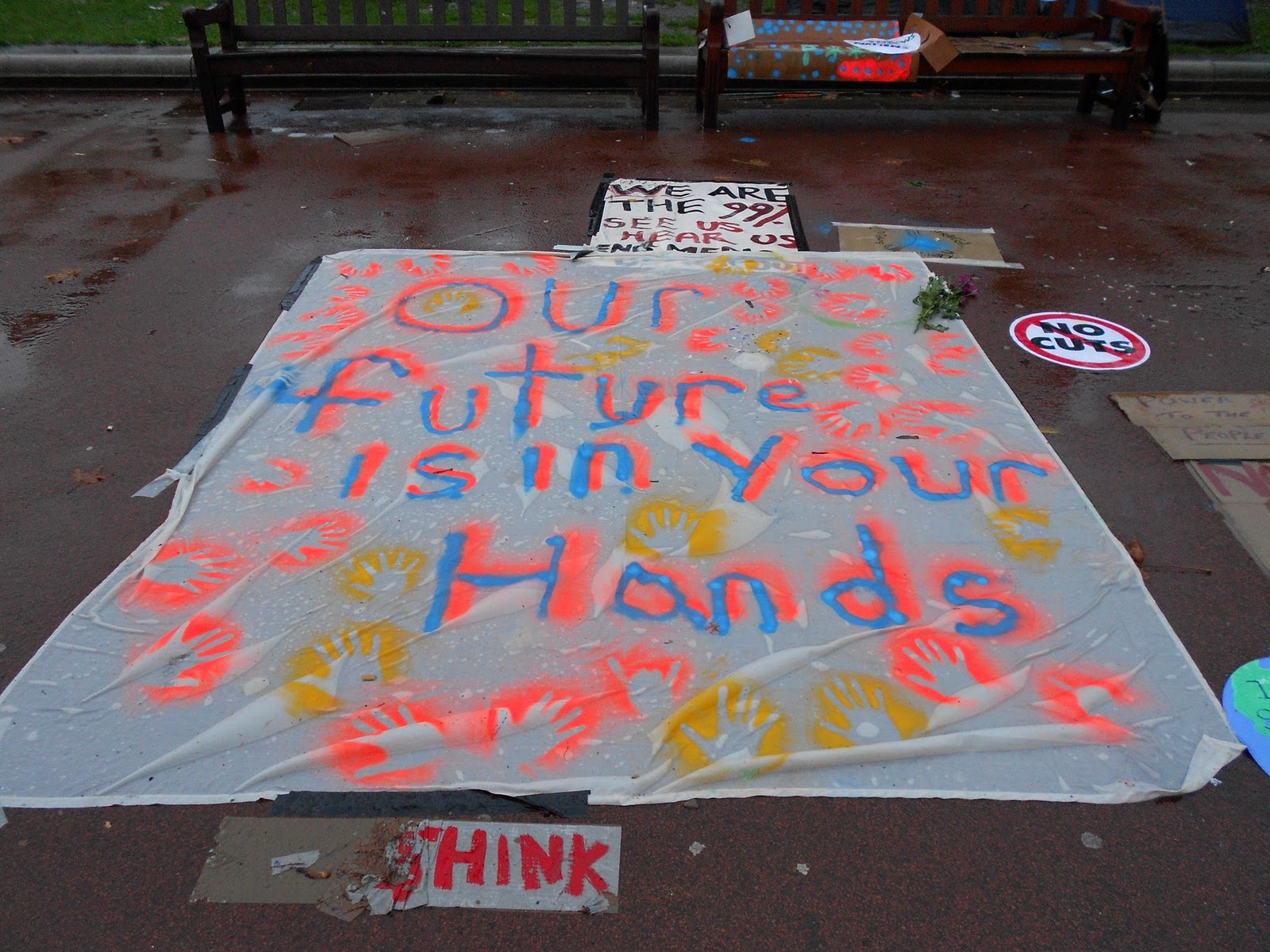


This is happening in George Square, one of the most well know areas in Glasgow. In 1919 tanks rolled across its ground against the mass demonstration taking place. In 2011 Glasgow City Council are welcoming the protesters - for now.
It took Occupy Wall Street almost a month to be reported in the main stream media. Will the same happen in Glasgow: home to the 'Red Clydeside'; home to the famous 'nae hooligans...nae vandalism...nae bevying...' ethos adopted by the Upper Clyde Shipbuilders in the 1970s?
Get down and show your support to them. They're based on George Square. Look out for the tents and the gazebos. They need bin bags, warm clothes but most of all they need your support.
This revolution will not be televised. Instead it will be broadcast via the web. Find out more at:
Occupy Glasgow Twitter
Occupy Glasgow website
Occupy Glasgow Facebook
Wednesday, 12 January 2011
Why Libraries Are Important
I feel I'm going to be preaching to the converted with this post but here we go.
This morning the Museums Libraries and Archives twitter feed tweeted a link to this article posted by the Guardian about the closure of libraries in Yorkshire . The article itself doesn't concentrate on librarians views but more on the users (who are the important group here). Most users were rather horrified at the thought of their local library being marked for closure. The reporter visits an area called Eastfield, fifty miles from Scarborough. The library has been renamed a 'community resource centre' but it appears to live up to this glamorous title. According to the report only 1 in 4 homes in this area have access to the internet. The centre provides a vital resource by offering computers which is vital in the age of the digital economy. Many jobs call for basic computer literacy skills. I'm not sure if the reliance on computers is a good or a bad thing but that is a topic for another post. As well as offering computers the centre lends books and offers meeting room facilities for local groups. The average age of users did seem to be fifty and upwards. Either they filmed the report during school time or perhaps the local schools have well equipped libraries. I doubt the later is true.
One important issue highlighted here is the concept of digital poverty. I discovered this term when reading Don Tapscott's work for my Masters dissertation. As society and information moves into the digital domain, we forget people are left behind. Some people are lucky to afford to pay off their gas bill every month let alone splash out on a basic computer which still costs hundreds of pounds. You forget the monthly cost of paying for internet access as well (and the electricity to run it). This assumption that everything is online forgets that people need a decent amount of disposable income before they can consider having internet access at home.
Books, the internet, other information mediums are expensive. Libraries provide a vital centre point for access to information. That is where trained information professionals, like librarians, come into force. These individuals have spent time and effort studying navigation tools and access points for information. They know to make information available, how to help point people in the right direction. Yesterday I spent a good ten minutes trying to explain to a library user why articles they found on Google Books did not reflect the database systems and journals that the university had available. University is the first time for many people start navigating information for themselves. Without having trained individuals present to help guide them, people may find themselves overwhelmed with information whilst never finding what they are actually looking for. I am not being patronising, even after six years of being a student I still find information and research over whelming. How many times have you read an entire Wikipedia article without finding what you were looking for? That is why universities have subject librarians to help students. On a local level, outwith the education sector, a reference librarian can help the keen amateur, the confused high school student, the new parent wanting 'How to...' guides.
Although with the increase in tuition fees, many individuals may find university closed off to them. They will not have opportunities to learn how to gather and analyse information. Local libraries may find themselves picking up the slack with hardly any resources to combat it. Volunteers are useful (being a volunteer myself I have to speak up for them) but people that are time rich may lack the skills needed to provide a good service. Volunteers might be unable to see past the services they want from a library and be blind to what others want. They may choose to reduce the number of computers to make way for more Catherine Cookson books. Or sell off the DVD collection to raise more money for comfy sofas. Or they may choose to weed out books they find unsuitable for readers. Or decided to end the costly subscription to online journals because they don't see the point of it.
A user at my volunteer workplace with was so grateful for the service of the library. Without it they would not have a quiet, suitable place to study. Without the services of the librarian they would have not been able to find relevant material for their coursework. The librarian at this institution is a paid, qualified member of staff who is currently re-cataloguing the book collection. They have created a catalogue/access point that is suitable for the users of the library and is much more effort than labelling each book a different number. Without her experience and knowledge it would be impossible to navigate the available resources this institution has to offer.
Closing libraries is robbing people's entitlement to knowledge and learning. Libraries, learning and resource centres, information signals, whatever you want to call them are vitally important. In times when people's disposable income is being cut there needs to be access to resources. Not everyone can afford to buy books off Amazon nor do they have the internet access to use their service. This concept might be difficult for the Powers That Be to understand. After all, most of them were educated during an era of free grants for students. Most probably did not need to use their local library due to facilities they had in their parents' homes. They forget that not everyone has that luxury. Closure of libraries highlights the widening gap between Britain's rich and poor in society. The new poverty this decade we will see will be those who lack access to information. That is a truly depressing thought.
This morning the Museums Libraries and Archives twitter feed tweeted a link to this article posted by the Guardian about the closure of libraries in Yorkshire . The article itself doesn't concentrate on librarians views but more on the users (who are the important group here). Most users were rather horrified at the thought of their local library being marked for closure. The reporter visits an area called Eastfield, fifty miles from Scarborough. The library has been renamed a 'community resource centre' but it appears to live up to this glamorous title. According to the report only 1 in 4 homes in this area have access to the internet. The centre provides a vital resource by offering computers which is vital in the age of the digital economy. Many jobs call for basic computer literacy skills. I'm not sure if the reliance on computers is a good or a bad thing but that is a topic for another post. As well as offering computers the centre lends books and offers meeting room facilities for local groups. The average age of users did seem to be fifty and upwards. Either they filmed the report during school time or perhaps the local schools have well equipped libraries. I doubt the later is true.
One important issue highlighted here is the concept of digital poverty. I discovered this term when reading Don Tapscott's work for my Masters dissertation. As society and information moves into the digital domain, we forget people are left behind. Some people are lucky to afford to pay off their gas bill every month let alone splash out on a basic computer which still costs hundreds of pounds. You forget the monthly cost of paying for internet access as well (and the electricity to run it). This assumption that everything is online forgets that people need a decent amount of disposable income before they can consider having internet access at home.
Books, the internet, other information mediums are expensive. Libraries provide a vital centre point for access to information. That is where trained information professionals, like librarians, come into force. These individuals have spent time and effort studying navigation tools and access points for information. They know to make information available, how to help point people in the right direction. Yesterday I spent a good ten minutes trying to explain to a library user why articles they found on Google Books did not reflect the database systems and journals that the university had available. University is the first time for many people start navigating information for themselves. Without having trained individuals present to help guide them, people may find themselves overwhelmed with information whilst never finding what they are actually looking for. I am not being patronising, even after six years of being a student I still find information and research over whelming. How many times have you read an entire Wikipedia article without finding what you were looking for? That is why universities have subject librarians to help students. On a local level, outwith the education sector, a reference librarian can help the keen amateur, the confused high school student, the new parent wanting 'How to...' guides.
Although with the increase in tuition fees, many individuals may find university closed off to them. They will not have opportunities to learn how to gather and analyse information. Local libraries may find themselves picking up the slack with hardly any resources to combat it. Volunteers are useful (being a volunteer myself I have to speak up for them) but people that are time rich may lack the skills needed to provide a good service. Volunteers might be unable to see past the services they want from a library and be blind to what others want. They may choose to reduce the number of computers to make way for more Catherine Cookson books. Or sell off the DVD collection to raise more money for comfy sofas. Or they may choose to weed out books they find unsuitable for readers. Or decided to end the costly subscription to online journals because they don't see the point of it.
A user at my volunteer workplace with was so grateful for the service of the library. Without it they would not have a quiet, suitable place to study. Without the services of the librarian they would have not been able to find relevant material for their coursework. The librarian at this institution is a paid, qualified member of staff who is currently re-cataloguing the book collection. They have created a catalogue/access point that is suitable for the users of the library and is much more effort than labelling each book a different number. Without her experience and knowledge it would be impossible to navigate the available resources this institution has to offer.
Closing libraries is robbing people's entitlement to knowledge and learning. Libraries, learning and resource centres, information signals, whatever you want to call them are vitally important. In times when people's disposable income is being cut there needs to be access to resources. Not everyone can afford to buy books off Amazon nor do they have the internet access to use their service. This concept might be difficult for the Powers That Be to understand. After all, most of them were educated during an era of free grants for students. Most probably did not need to use their local library due to facilities they had in their parents' homes. They forget that not everyone has that luxury. Closure of libraries highlights the widening gap between Britain's rich and poor in society. The new poverty this decade we will see will be those who lack access to information. That is a truly depressing thought.
Thursday, 13 May 2010
Politics
Those living in the UK can't have failed to have noticed that an election took place last week. For non UK readers, two centres of power control my life. One is the devolved parliament of Scotland which is based in Edinburgh. Its representatives are elected using a proportional representation system. The Scottish National Power has the biggest share of seats but not enough to claim a majority of government. They have 47 seats of a potential 129. At the moment they are puttering along and doing reasonably well. Although I strongly think they will lose their hold in the next Scottish elections but that's for another time. The Scottish Parliament deals with a lot of issues excluding taxation and foreign policy. These powers belong to Westminister, which was the subject of the elections last week.
Despite having a devolved parliament, Scotland is not a sovereign country. As much as I would love to live in a completely independent country, I do not think we have the economy to support this. Scotland has been hit badly by the recession (not as bad as previous recessions but still.....) and would have probably been crippled if we had been operating outwith the UK political framework. Anyway, the representation system at Westminister is slightly different. It operates on a First Past the Post system. The party that reaches 326 seats first wins the election. So far, so unfair. But that didn't happen this time round. The problem has arisen due to the Conservatives only polling 306 seats. Not enough to make a majority government. The British political scene has been interesting to watch the past couple of days. Unfortunately talks have resulted in a Conservative/Liberal Democrat coalition.
Having the Conservatives in power does not bode well for Scotland. I am too young to remember the Poll Tax protests yet the effects are still being felt. In my last job an older colleague admitted he was still paying back his Poll Tax 'debt' after refusing to pay for it. It speaks volumes that Scotland only has one elected MP at Westminister. Scotland was once the jewel in Britain's heavy industry crown; the Clydeside in Glasgow had hundreds of shipyards churning out ships day and night. Now there are only two active shipyards if my memory serves me right. The Tories do not care about what happens in the UK, outside of their southern English strong hold. The Scottish Parliament's purse strings are controlled by Westminister. With the Tories in power, I can see those funds being dramatically cut.
Alas the SNP became something of a joke during this election, with their attempts to the broadcast of the televised debates. It smacked of a child spitting its dummy out of the pram. I do believe that more parties should have been present in these debates. It was the first time such debates had been broadcast. I understand these are a staple part of the American Presidential campaign and I hope we keep them. The SNP could have teamed up with the other 'minority' parties and presented a united, dignified front for other parties to have a chance at the debating podium. Instead they cried "WAAAAAHHHHHH!" and stamped their feet.
All I can say is that I did not vote for any of the big three parties (Labour, Lib Dems or Conservatives) or the SNP. I vote but rarely find a party that corresponds to all of my political beliefs. Yet I find myself unable to not vote. Perhaps it's because I'm a woman and am well versed at the struggle for female voters. To be quite frank, the struggle for women is still going on. At least I live somewhere that I have the freedom to vote, for whichever party I please and for my political voice to at least have the illusion it is being heard.
With the Conservatives in power, I hope for more people to engage with politics. Not to think politics is boring or a waste of time or useless. This time I am old enough to take part in the protests because there will be protests. Anyone who is not exclusively white, male, upper middle class, married with children and leans politically to the right of the centre is going to be fucked over by this new government.
Will the revolution be televised?
Despite having a devolved parliament, Scotland is not a sovereign country. As much as I would love to live in a completely independent country, I do not think we have the economy to support this. Scotland has been hit badly by the recession (not as bad as previous recessions but still.....) and would have probably been crippled if we had been operating outwith the UK political framework. Anyway, the representation system at Westminister is slightly different. It operates on a First Past the Post system. The party that reaches 326 seats first wins the election. So far, so unfair. But that didn't happen this time round. The problem has arisen due to the Conservatives only polling 306 seats. Not enough to make a majority government. The British political scene has been interesting to watch the past couple of days. Unfortunately talks have resulted in a Conservative/Liberal Democrat coalition.
Having the Conservatives in power does not bode well for Scotland. I am too young to remember the Poll Tax protests yet the effects are still being felt. In my last job an older colleague admitted he was still paying back his Poll Tax 'debt' after refusing to pay for it. It speaks volumes that Scotland only has one elected MP at Westminister. Scotland was once the jewel in Britain's heavy industry crown; the Clydeside in Glasgow had hundreds of shipyards churning out ships day and night. Now there are only two active shipyards if my memory serves me right. The Tories do not care about what happens in the UK, outside of their southern English strong hold. The Scottish Parliament's purse strings are controlled by Westminister. With the Tories in power, I can see those funds being dramatically cut.
Alas the SNP became something of a joke during this election, with their attempts to the broadcast of the televised debates. It smacked of a child spitting its dummy out of the pram. I do believe that more parties should have been present in these debates. It was the first time such debates had been broadcast. I understand these are a staple part of the American Presidential campaign and I hope we keep them. The SNP could have teamed up with the other 'minority' parties and presented a united, dignified front for other parties to have a chance at the debating podium. Instead they cried "WAAAAAHHHHHH!" and stamped their feet.
All I can say is that I did not vote for any of the big three parties (Labour, Lib Dems or Conservatives) or the SNP. I vote but rarely find a party that corresponds to all of my political beliefs. Yet I find myself unable to not vote. Perhaps it's because I'm a woman and am well versed at the struggle for female voters. To be quite frank, the struggle for women is still going on. At least I live somewhere that I have the freedom to vote, for whichever party I please and for my political voice to at least have the illusion it is being heard.
With the Conservatives in power, I hope for more people to engage with politics. Not to think politics is boring or a waste of time or useless. This time I am old enough to take part in the protests because there will be protests. Anyone who is not exclusively white, male, upper middle class, married with children and leans politically to the right of the centre is going to be fucked over by this new government.
Will the revolution be televised?
Sunday, 4 January 2009
American Man with an Opinion
I always seem to attract people who like to talk. Maybe I have one of those faces. Once I spent three hours chatting with an Israeli tourist in a Pret A Manger in Glasgow about, well, nothing in particular.
On Friday I was meeting a friend at the bus station. It being the first 'business as normal day' post-New Year the place was mobbed and full of people either returning to Glasgow after the festive period or getting the hell out of this crazy city. I managed to find an empty bench and a few seconds later an elderly gent sat next to me. Elderly, I'd say he was in his early sixties. We got chit chatting and he asked me what I was doing at the bus station. I explained I was waiting for a friend and we were going to the cinema to see The Reader. For those that don't know, part of the plot is concerned with war crimes in World War II.
The gent nodded and said "You know, people talk about war crimes as if they never happen anymore. But what is going on in Gaza at the moment...to me that's a war crime. And on both sides may I add. Hamas ain't innocent but the Israelis are just as bad."
War crimes are the de jour phrase at the moment. This morning I read in the paper that a Rwandian singer called Simon Bikindi was sentenced to 15 years in prison for using his music to incite violence during that fateful time in 1994. Not a politician, not a member of the military. A mere singer. Could the actions of Robert Mugabe be classed as war crimes? He seems locked in conflict with his own people, officials from neighbour states, the United Nations and just about anyone else who disagrees with the suffering and pain he is inflicting on his country.
I am not even going to pretend I know enough about the Middle East situation to comment. All I shall say is that it is ordinary people that are getting hurt, being killed. And surely that makes it a war crime and, if it doesn't sound too pompous, a crime against humanity.
On Friday I was meeting a friend at the bus station. It being the first 'business as normal day' post-New Year the place was mobbed and full of people either returning to Glasgow after the festive period or getting the hell out of this crazy city. I managed to find an empty bench and a few seconds later an elderly gent sat next to me. Elderly, I'd say he was in his early sixties. We got chit chatting and he asked me what I was doing at the bus station. I explained I was waiting for a friend and we were going to the cinema to see The Reader. For those that don't know, part of the plot is concerned with war crimes in World War II.
The gent nodded and said "You know, people talk about war crimes as if they never happen anymore. But what is going on in Gaza at the moment...to me that's a war crime. And on both sides may I add. Hamas ain't innocent but the Israelis are just as bad."
War crimes are the de jour phrase at the moment. This morning I read in the paper that a Rwandian singer called Simon Bikindi was sentenced to 15 years in prison for using his music to incite violence during that fateful time in 1994. Not a politician, not a member of the military. A mere singer. Could the actions of Robert Mugabe be classed as war crimes? He seems locked in conflict with his own people, officials from neighbour states, the United Nations and just about anyone else who disagrees with the suffering and pain he is inflicting on his country.
I am not even going to pretend I know enough about the Middle East situation to comment. All I shall say is that it is ordinary people that are getting hurt, being killed. And surely that makes it a war crime and, if it doesn't sound too pompous, a crime against humanity.
Wednesday, 13 June 2007
No Karaoke please, we're Scottish.
I've returned from a week in Sunny Beach, Bulgaria. My parents were fond of taking holidays in very quiet areas of Portugal. Very quiet areas where a passing horse and cart is big news. OK I may exaggerate but I've rarely been to a big resort location such as Spain. Bulgaria was suggested to us by the travel agents and I heard it was reasonably cheap. Of course that looks like it is about to change because Bulgaria joined the EU at the beginning of this year.
One day Him Indoors and I decided to take a tour to the cities of Nessebar and Burgas. Both places were an experience. Burgas made me feel like I was in a production of 'The Third Man' and I kept expecting to see Orson Welles strutting around the square and muttering something about cuckoo clocks. The experience of that city made me feel like a fat and reasonably wealthy European. There was a small family of beggars wandering about. One little girl tried to take a tourist's ice cream cone headed for the bin and was loudly told to 'Fuck off' by the six foot English inbred idiot who possessed it. Myself I was pissed off by the kids coming up to me whilst I was trying to read my book but I ignored them. I had used up all my energy glaring at someone on the tour bus who used the word 'Pikey' to describe the Gypsy population.
Our tour guide was a charming Bulgarian girl who Anglicised her name to Daisy. This was a common occurrence amongst the Bulgarians I encountered in hotels and restaurants. On the transport between Burgas and Nessebar she offered up a Q& A session and answered some rather interesting questions. One was about the EU and she remarked that it was becoming more expensive to live in Bulgaria. The average Bulgarian takes home around 300 levs a month which is approximately £100. I'm sure Mr West could explain the ins and outs of requirements countries need to fill before being allowed EU membership better than I can. According to Daisy the cost of living and essentials such as water and electricity are going up but the wages are not rising to cope with this. She commented that most of the farm land in Bulgaria is going to waste due to the ghost of the Communist regime. Very little of the younger population has any interest in farming so most of the land is being sold for property development. Our hotel was across the road from a very busy building site so I can testify to that. To give you an idea of the development, our hotel was near the back end of Sunny Beach. Here are some photos taken from our balcony and the restaurant:


Please note this is only a small sample but there are literally hotels as far as the eye can see. Of course, tourists bring money with them. There were hundreds of restaurants and bars yet most of them seemed to tout one USP.
Karaoke.
Nearly every bloody bar we went to had sodding karaoke. One night we were having a meal in a local restaurant and, halfway through our dinner, a musician (I use that term loosely) struck up his guitar and started belted out classics such as 'Alice? Who the fuck is Alice?' and 'Stairway to Heaven'. The drunken English party sitting beside him were lapping this up and screeching along with him. Him Indoors reported one half of the restaurant was loving every minute of this 'entertainment' whilst the other half look horrified they had ordered desserts and had to prolong this agony. The food was very nice but I am an old fashioned fart in that I like to have conversations with the person I am having a meal with. I do not want to have to raise my voice over 20 drunkards and 1 very bad musician.
Rant over. Having said that Bulgaria is a rather charming country and tipping is not expected. In a country where a good cup of coffee costs 60p I felt rather guilty if I didn't tip the waitress the extra few levs from my change. A decent three course meal with wine can be bought for under £20, again in the more expensive areas. The bar and restaurant staff seem genuinely grateful for any tips, no matter how small. One waitress seem positively puzzled when I handed back my 2lev change. I hope to return to Bulgaria in a few years to see how much, or how little, it has changed.
One day Him Indoors and I decided to take a tour to the cities of Nessebar and Burgas. Both places were an experience. Burgas made me feel like I was in a production of 'The Third Man' and I kept expecting to see Orson Welles strutting around the square and muttering something about cuckoo clocks. The experience of that city made me feel like a fat and reasonably wealthy European. There was a small family of beggars wandering about. One little girl tried to take a tourist's ice cream cone headed for the bin and was loudly told to 'Fuck off' by the six foot English inbred idiot who possessed it. Myself I was pissed off by the kids coming up to me whilst I was trying to read my book but I ignored them. I had used up all my energy glaring at someone on the tour bus who used the word 'Pikey' to describe the Gypsy population.
Our tour guide was a charming Bulgarian girl who Anglicised her name to Daisy. This was a common occurrence amongst the Bulgarians I encountered in hotels and restaurants. On the transport between Burgas and Nessebar she offered up a Q& A session and answered some rather interesting questions. One was about the EU and she remarked that it was becoming more expensive to live in Bulgaria. The average Bulgarian takes home around 300 levs a month which is approximately £100. I'm sure Mr West could explain the ins and outs of requirements countries need to fill before being allowed EU membership better than I can. According to Daisy the cost of living and essentials such as water and electricity are going up but the wages are not rising to cope with this. She commented that most of the farm land in Bulgaria is going to waste due to the ghost of the Communist regime. Very little of the younger population has any interest in farming so most of the land is being sold for property development. Our hotel was across the road from a very busy building site so I can testify to that. To give you an idea of the development, our hotel was near the back end of Sunny Beach. Here are some photos taken from our balcony and the restaurant:


Please note this is only a small sample but there are literally hotels as far as the eye can see. Of course, tourists bring money with them. There were hundreds of restaurants and bars yet most of them seemed to tout one USP.
Karaoke.
Nearly every bloody bar we went to had sodding karaoke. One night we were having a meal in a local restaurant and, halfway through our dinner, a musician (I use that term loosely) struck up his guitar and started belted out classics such as 'Alice? Who the fuck is Alice?' and 'Stairway to Heaven'. The drunken English party sitting beside him were lapping this up and screeching along with him. Him Indoors reported one half of the restaurant was loving every minute of this 'entertainment' whilst the other half look horrified they had ordered desserts and had to prolong this agony. The food was very nice but I am an old fashioned fart in that I like to have conversations with the person I am having a meal with. I do not want to have to raise my voice over 20 drunkards and 1 very bad musician.
Rant over. Having said that Bulgaria is a rather charming country and tipping is not expected. In a country where a good cup of coffee costs 60p I felt rather guilty if I didn't tip the waitress the extra few levs from my change. A decent three course meal with wine can be bought for under £20, again in the more expensive areas. The bar and restaurant staff seem genuinely grateful for any tips, no matter how small. One waitress seem positively puzzled when I handed back my 2lev change. I hope to return to Bulgaria in a few years to see how much, or how little, it has changed.
Sunday, 27 May 2007
STOP PRESS! WWAO agrees with Iain Banks
It must be compulsory for wannabe writers in fifth year at school to read The Wasp Factory and marvel at it.
It's not very good. Perhaps I was somewhat jaded when I read it for the first time. The book was the same age as me when I picked it up from the 'Older Students' section of my school library. The slim book was finished in a weekend and I was not left very impressed. In 1984, the year Orwellians were doing Jones impressions of "We're all doomed!", readers may have been more shocked at images of maggots feeding off living brains. And the brains of children for that matter.
Next came an attempt to read The Crow Road. Twice I picked up that heavy volume and twice it was returned to the library unread. It was not until this year that I finally finished a copy. Again the story was about nothing. I may have missed out on some wonderful metaphor for life but, honestly, it was really about the main character getting his hole wasn't it? But it was well written and had enough interesting plot twists to keep the reader engaged. Better than some of the painfully written tripe that appears on the lists of book trendsetters such as Richard and Judy.
And your point caller? I was reading through yesterday's email edition of The Guardian. The bibliophile's dirty weekend, or the Guardian Hay Festival, is under way and Mr Banks is appearing at it. Having published his first novel in years he needs to do something to promote it. Hence the article I read in this weekend's Guardian. Unlike some writers who like cowering away from politics, Banks makes no qualms about it. He famously ripped up his passport when Blair went to war against Iraq (please note, Britain didn't go to war) and stamped his literate foot in Dead Air.
One thing annoys me about Guardian interviewers is the immature attitude they take. Honestly, why would you suggest weeing in a swimming pool to a man in his 50s? However, there are some gems in this article. The following quote sums up a lot of my feelings on America:
"Personally, I believe when faced with an imperial power - and let's not kid ourselves, that's exactly what the USA is - one ought to do everything nonviolent one can to resist it, just on principle. The USA is a great country full of great people. It's just their propensity as a whole for electing idiots and then conducting a foreign policy of the utmost depravity that I object to."
The full article is here for anyone who is interested.
It's not very good. Perhaps I was somewhat jaded when I read it for the first time. The book was the same age as me when I picked it up from the 'Older Students' section of my school library. The slim book was finished in a weekend and I was not left very impressed. In 1984, the year Orwellians were doing Jones impressions of "We're all doomed!", readers may have been more shocked at images of maggots feeding off living brains. And the brains of children for that matter.
Next came an attempt to read The Crow Road. Twice I picked up that heavy volume and twice it was returned to the library unread. It was not until this year that I finally finished a copy. Again the story was about nothing. I may have missed out on some wonderful metaphor for life but, honestly, it was really about the main character getting his hole wasn't it? But it was well written and had enough interesting plot twists to keep the reader engaged. Better than some of the painfully written tripe that appears on the lists of book trendsetters such as Richard and Judy.
And your point caller? I was reading through yesterday's email edition of The Guardian. The bibliophile's dirty weekend, or the Guardian Hay Festival, is under way and Mr Banks is appearing at it. Having published his first novel in years he needs to do something to promote it. Hence the article I read in this weekend's Guardian. Unlike some writers who like cowering away from politics, Banks makes no qualms about it. He famously ripped up his passport when Blair went to war against Iraq (please note, Britain didn't go to war) and stamped his literate foot in Dead Air.
One thing annoys me about Guardian interviewers is the immature attitude they take. Honestly, why would you suggest weeing in a swimming pool to a man in his 50s? However, there are some gems in this article. The following quote sums up a lot of my feelings on America:
"Personally, I believe when faced with an imperial power - and let's not kid ourselves, that's exactly what the USA is - one ought to do everything nonviolent one can to resist it, just on principle. The USA is a great country full of great people. It's just their propensity as a whole for electing idiots and then conducting a foreign policy of the utmost depravity that I object to."
The full article is here for anyone who is interested.
Subscribe to:
Posts (Atom)